
But the city has not been graced with the easiest of histories. On our third day, we decided to visit the heart of the insanity that was the Khmer Rouge regime, namely the Killing Fields at Choeung Ek and the Tuol Sleng, or S-21 prison. In an effort to usher in a demented form of "communism," genocidal Pol Pot and the leaders of the Khmer Rouge decided that it was necessary to torture and kill intellectuals, tradesmen, political opponents, politicians and pretty much anyone else that got in their way. The result was that over 40% of the population of the entire country was tortured and murdered. 40%. And as if that weren't crazy enough, the regime borrowed a page from the Nazi handbook and kept detailed records of all of the people who they felt it necessary to kill.
Our first stop was at the Killing Fields, one of hundreds of places throughout Cambodia where people, from infants, to the elderly where executed. To say that the experience was difficult is a colossal understatement. At the entrance of the site, a bone pagoda sits with the skulls of hundreds of murdered people in levels rising high overhead. Walking around the hastily dug pits where thousands were buried and seeing fragments of bones still embedded in the earth was heartbreaking. As we continued around the site trying our best to keep from crumbling, our tour guide pointed out the butterflies that swarmed all around the burial pits but nowhere else around the site. For Buddhists, this notion of the souls of the tortured and murdered returning to grace the graceless site seemed to offer the closest thing to comfort.
The next site was the infamous S-21 prison. S-21 was one of the Khmer Rouge's central processing points and torture facility. The methods employed were simple: starve, torture and humiliate people until they confessed to a trumped-up charge, and then execute them. What makes the place even more absurdly terrible is that it was a converted high school. The grounds still look like any typical high school anywhere in the world with manicured lawns and a central quad. Inside the campus buildings is the incredibly moving tribute of line after line of photos. Each of the thousands that came through were photographed upon entry or prior to execution. And seeing the faces of children, teenagers, the middle-aged and old and knowing the fate that they endured made it difficult to fathom the horrors that humans can commit.
Unfathomably, many tourists combine a tour of these sites with a stop-off at a nearby shooting range to try their hand at shooting an A-K. Needless to say, we skipped that part. We felt like we needed at least one class in Cold War politics to understand the Khmer Rouge, as well as the current political situation in Cambodia.
And what of a city, no less a country, that endures this kind of hardship? Many of the people who were directly affected by the Khmer Rouge, either as victims or indoctrinated as soldiers and child soldiers are trying to go about their daily lives. But this is the amazing thing, the people are guarded, but wonderfully sweet and open once you get to know them a bit. There is the sense that while the scars that were inflicted from 1975-1979 are still there, the people remain, somehow, hopeful.
While it was hard to leave behind the images and emotions of the Killing Fields and S-21 and return to the world of tourist, we spent the next 3 days exploring the myriad neighborhoods, eating wonderful food and drinking an absurd amount of fruit shakes.
By the end of our five days, Phnom Penh became one of my favorite cities. With a mix of beauty and tragedy, of bustle and sweetness, it is one of the places I could easily imagine living in.
-d
Tuesday, January 22, 2008
Phnom Penh

Monday, January 14, 2008
Battambang
Exactly!
-K
Saturday, January 12, 2008
Don't Fear the Siem Reaper
But first, a brief note about the town of Siem Reap. After the languid rhythm of Laos, the city is a bit of a shock. With the UNESCO World Heritage draw of Angkor nearby, the place is a boomtown. But in the context of Cambodia, a boomtown tends to mean massive construction of luxury hotels without paying any mind to city planning and infrastructure like garbage pickup, or paving roads. The result is that the town feels a bit schizophrenic. It is vibrant and dirty, chaotic and filled with tourists.
On to Angkor. We decided to get the three day pass because our research made clear that one day was nowhere near enough. But with all of the research came the usual anxiety: everyone raves about Angkor Wat and we worried that we would be underwhelmed. There was not reason to be concerned. The place is amazing. Representing 400 years of Khmer culture, the ruins are a massive conglomeration of buildings filled with intricate bas relief carvings seemingly on every surface. What we hadn't fully comprehended was the scale of the entire area. Structures are spread out over a 20 KM square area whose organization, some believed, was an early representation of the universe. What that meant for us was that we had to hire a tuk tuk for each day just to get around.
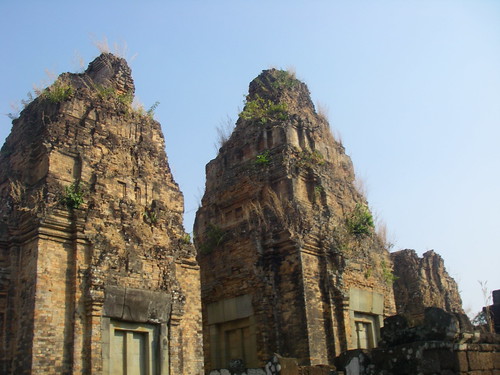
Someone somewhere along our travels recommended we do the smaller structures first, working our way to Angkor Wat. We spent the first day exploring the outlying structures northeast of the main Angkor Wat and Angkor Thom central complexes. Our first and possibly favorite stop was at Preah Kahn, an enormous and intricate labyrinth of buildings that combined well preserved carvings with complete ruin. It's hard to really describe the experience of seeing all of these sites, other than to say the buildings all combine Hindu and Buddhist iconography, but are all unique, and climbing unbelievably steep stone stairs and scrambling over ruins results in a sweaty sweaty day. (And at some point we'll get around to uploading all those photos).
By the time we got to the actual structure of Angkor Wat on the second day, we were still amazed. We decided to stay into the evening to watch sunset from a hilltop temple, along with about 1,000 other people, which turned into a fun people watching opportunity and pretty great sunset.
-K & D
